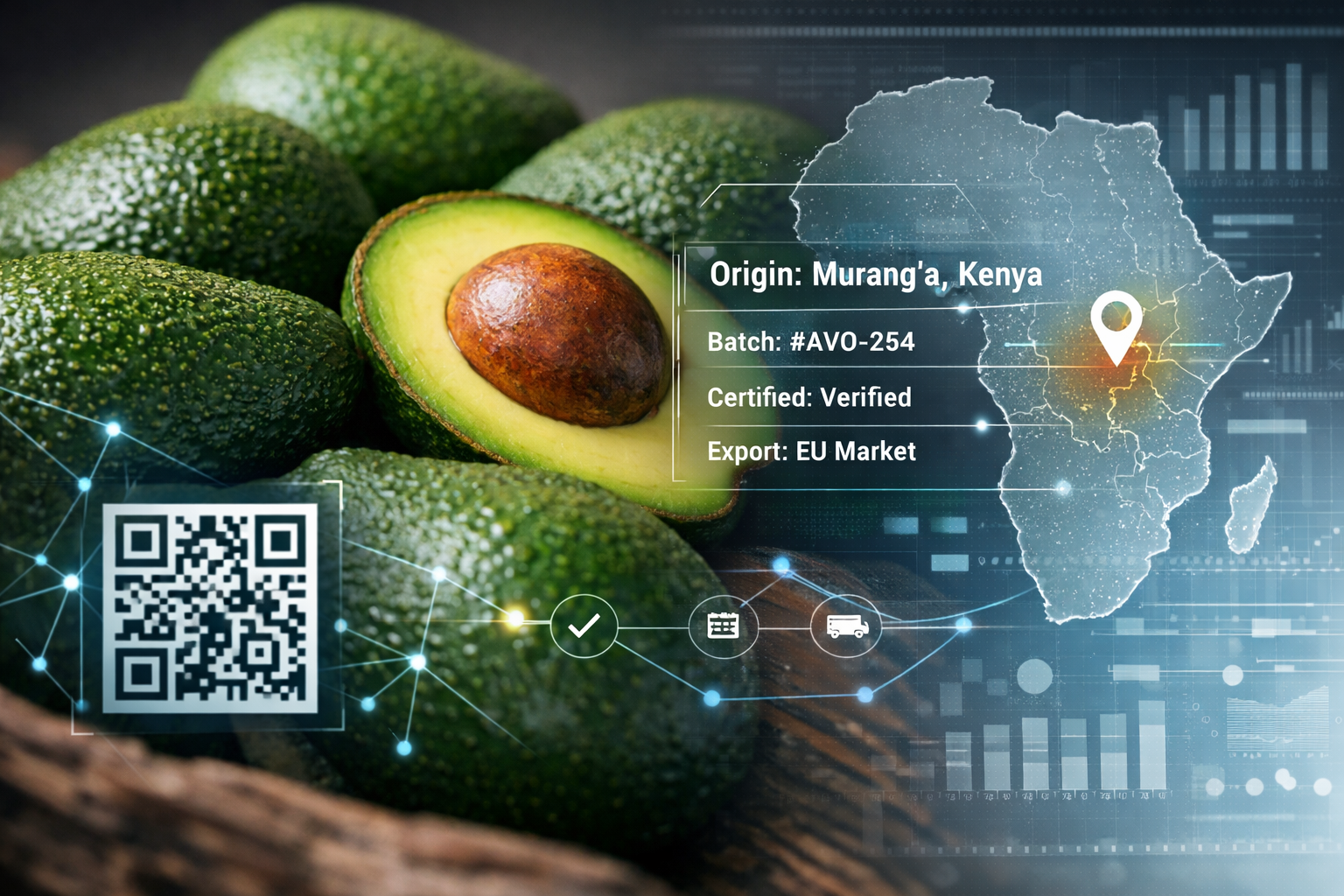
In Kenya’s tropical farms, a farmer carefully harvests a batch of premium avocados, destined for a supermarket chain in Europe. Weeks later, a buyer in Amsterdam receives a shipment with quality issues: some fruit is bruised and some, coming from an under-ripe batch, is rotten rather than ripening. The Kenyan exporter faces a crisis: which farm did this batch come from? Which aggregator mixed the shipment? Without clear answers, they can’t reassure the buyer, address the root cause, or prevent it from happening again. This brings another risk where the relationship, and future orders, hang in the balance.
This isn’t an isolated incident. It’s a systemic “proof problem” crippling African trade.
From avocados and mangoes in Kenya, to nuts and tea tree oils, crafts and apparels and the emerging lifestyle minerals and cosmetic clays, African producers face the same daunting gap: they grow, mine, weave, craft and create world-class products, but they lack the trusted, verifiable systems to prove origin, quality, and integrity to the global market.
Without this proof, trust erodes, orders get cancelled, and Africa’s products are perpetually undervalued or locked out of premium markets.
The High Cost of Mixed Batches and Missing Data
The issue goes beyond a single spoiled shipment. It’s about the entire structure of trust:
- The blame game: When a "mixed batch" fails, who is accountable? The smallholder farmer, the local aggregator, the processor, or the exporter? Without traceability, it’s everyone and no one leading to internal disputes and a breakdown of the supply chain.
- The discount dilemma: Global buyers, burned by inconsistency, apply a universal "risk discount." Even excellent products from ethical sources get lower offers because the buyer cannot verify their story. The premium for organic, fair-trade, or single-origin is lost in the fog of aggregation.
- Market lock-out: Increasingly, regulations (like the EU’s deforestation law) and consumer demand mandate proof of sustainable and ethical sourcing. Paper certificates and manual ledgers are no longer sufficient. African SMEs without digital provenance are seeing doors close.
Africa doesn’t have a product problem. It has a proof problem.
Introducing the Infrastructure for Trust: Ivrify’s Provenance Layer
The solution is not more promises; it is verifiable data. This is where traceability and provenance become economic infrastructure.
At Ivrify, we provide a shared provenance data layer: a consistent way to capture, link, and verify chain-of-custody events across many actors and tools.
How Ivrify Turns Crisis into Credibility:
- 1. Source-to-Market Digital Provenance: Imagine every box of avocados, every bag of Machakos clay with a digital record. Ivrify’s infrastructure underpins this process by providing a traceability layer that creates and ties immutable records directly to the physical source, from the individual farm plot to the specific clay deposit in Muthwani ward. In addition to recording the product’s origin, every step in harvesting, washing, aggregation, and shipping is logged and verified into a single history accessible via QR codes or secure portals.
- 2. Batch-level Traceability, not Guesswork: When a quality issue arises in Amsterdam, the exporter doesn’t panic. They scan the batch code. Instantly, they see: *Farm ID: 045 (Karimi Family Farm, Murang’a), Harvested: March 10, Aggregated by: GreenCoop Co-op, Processed at: XYZ Packhouse.* They can now address the specific issue, provide the buyer with transparent facts, and implement targeted fixes for the future. Trust is recovered through transparency.
- 3. Interoperable trust. We don’t ask producers to rip out their existing systems. Ivrify integrates with co-op and field-level platforms like TaroWorks and Farmforce, SACCO payment systems, county produce movement permits, HCD and KEPHIS certification records, and logistics APIs such as Leta or Amitruck. We transform fragmented paper trails into an automated audit log, building a trusted layer on our clients' existing data infrastructure. This provides regulators, financiers, and buyers data integrity they can act on.
- 4. From Compliance to Value Creation. For ventures like sourcing clays, crafts, gemstones, and apparels from Kenya, our infrastructure manages the entire chain, from onboarding verified cooperatives to ensuring automated compliance with export and sustainability standards. But provenance is more than a crisis-management tool; it’s your most powerful marketing asset. That verifiable data tells a story: “This pink clay mask contains Rhodic Ferralsols from the iron-rich slopes of the Yatta Plateau, sustainably harvested by the Katangi Women’s Cooperative.” This narrative commands premiums and builds brands that consumers love.
The Future of African Trade is Verifiable
The African Continental Free Trade Area (AfCFTA) and global trends are clear: the future belongs to transparent, value-led supply chains. The current pushback faced by Kenyan fruit sellers is an urgent signal, a market demanding the infrastructure that Ivrify provides.
We are here to provide not just compliance tech but to also help players unlock value with their existing systems through structured data infrastructure that turns disconnected apps and records into a coherent, trusted provenance network.
We are not just selling software. We are enabling a fundamental shift:
- For Producers & Exporters: Transition from being the cheapest option to being the most trusted source. Move from costly disputes to resilient, buyer-confident partnerships.
- For Africa: Move from exporting raw commodities to owning and sharing the full, valuable story of our products. Retain more value locally, reduce dependency on intermediaries, and build trust-based global partnerships.
The opportunity is to build markets where value is retained locally, where trust is built on data, and where every avocado, every mango, and every bag of cosmetic clay carries the undeniable proof of its quality and origin.
Traceability is not about control. It is about visibility, fairness, and value creation. The gap is no longer a gap in quality; it is a gap in trust. And that is a gap we can close.
Ivrify – Building the Data Foundation for Trusted Trade.