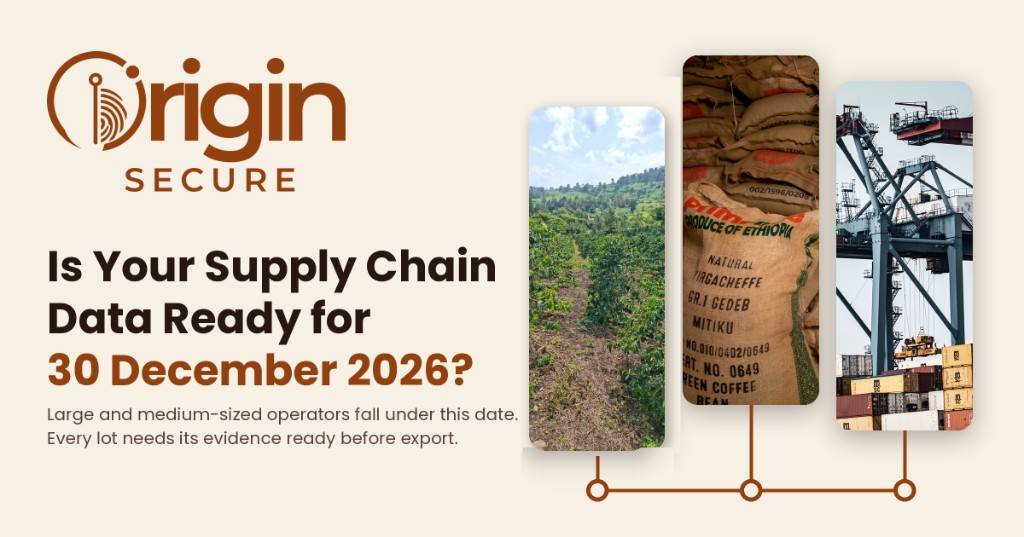
The application dates come from Regulation (EU) 2025/2650, which postponed and simplified the original Regulation (EU) 2023/1115. Under that timeline, the EUDR applies from two dates, not one. 30 December 2026 is the date that matters for most of the trade into the EU. 30 June 2027 is the later date for most remaining micro and small operators.
If you export coffee, cocoa or another covered commodity from Africa, the useful question is not only which date is on the calendar. It is whether the records behind each lot can be produced when a buyer asks.
Are the records behind your products ready?
What happens on 30 December 2026?
From that date, relevant products cannot be placed on the EU market or exported from the EU unless due diligence has already been completed. That is the operational event. It is not a soft launch, and it is not a reporting exercise after the shipment has moved.
The operator who places the product on the market, or exports it from the EU, must collect the required information, assess the risk of non-compliance, and mitigate that risk where needed, as set out in Regulation (EU) 2023/1115, as amended by Regulation (EU) 2025/2650. In practice, EU buyers, traders and competent authorities will expect plot-level geolocation, legality evidence and a deforestation-risk assessment to be available before the goods are accepted.
The European Commission publishes the current product scope. Coffee, cocoa, palm oil, rubber, soy, cattle and wood, and certain derived products, are in. Commission guidance and the implementation FAQ continue to be updated as implementation proceeds.
Regulation (EU) 2025/2650 also changed who files. Only the first operator placing a relevant product on the EU market, or exporting it from the EU, submits the due diligence statement. Downstream operators and traders pass along the statement’s reference number rather than filing their own.
Who is on which date?
Large and medium-sized operators generally fall under 30 December 2026. Micro and small operators already covered by the EU Timber Regulation also fall under that date. Most other micro and small operators have until 30 June 2027.
Those size classes follow the EU’s SME definition: micro undertakings have fewer than 10 staff; small have fewer than 50; medium have fewer than 250, with matching turnover or balance-sheet ceilings. If you are unsure which class you sit in, use that definition rather than a local label such as “SME”.
Many African exporters will not themselves be the EU operator who files the due diligence statement. They will still feel the deadline.
A European buyer who is in scope still needs geolocation, lot history and supplier evidence from the people upstream. That request often reaches the exporter before any EU filing date that applies to them. Some exporters are not operators under the regulation at all, so they have no EU filing date of their own. They still have to answer the buyer.
EUDR Explained covers operator, trader and exporter roles in more detail.
What a lot must be able to show
The part that takes months is not writing a policy. It is connecting production plots to export lots.
Plot-level geolocation is the part most agricultural exporters run out of time on: not a farm name or a district, but coordinates for the land where the commodity was produced.
Regulation (EU) 2025/2650 created a narrow exception. Micro or small primary operators in a country classified as low risk may, in defined cases, use a postal address instead of plot GPS. They file a one-time simplified declaration. That declaration includes an estimated annual quantity of the products they intend to place on the market or export.
That route is country-specific. It does not cover most African agricultural export lots. For those lots, plot-level geolocation is still the work that takes months to assemble.
By the time a buyer asks, a lot should be able to answer:
- Which plots produced it, with geolocation that can be checked against the 31 December 2020 deforestation cut-off.
- How those plots connect to the batch that is being shipped, including mixes from several farms or collection points.
- Where the supporting evidence sits, so it can be retrieved rather than reconstructed.
Spreadsheets, WhatsApp threads and farm books can hold the facts. They can’t connect those facts into a lot a buyer can check.
Where Origin Secure fits
Origin Secure captures plot-level origin at source and keeps that evidence attached as a batch moves through the supply chain. The public record a buyer can open is the same lineage the exporter holds.
It does not submit due diligence statements to the EU. It can organise plot, batch and evidence so the operator who does file is not working from disconnected files.